
Aconcagua
Elevation 6,962 m
Principal Cordillera Argentina
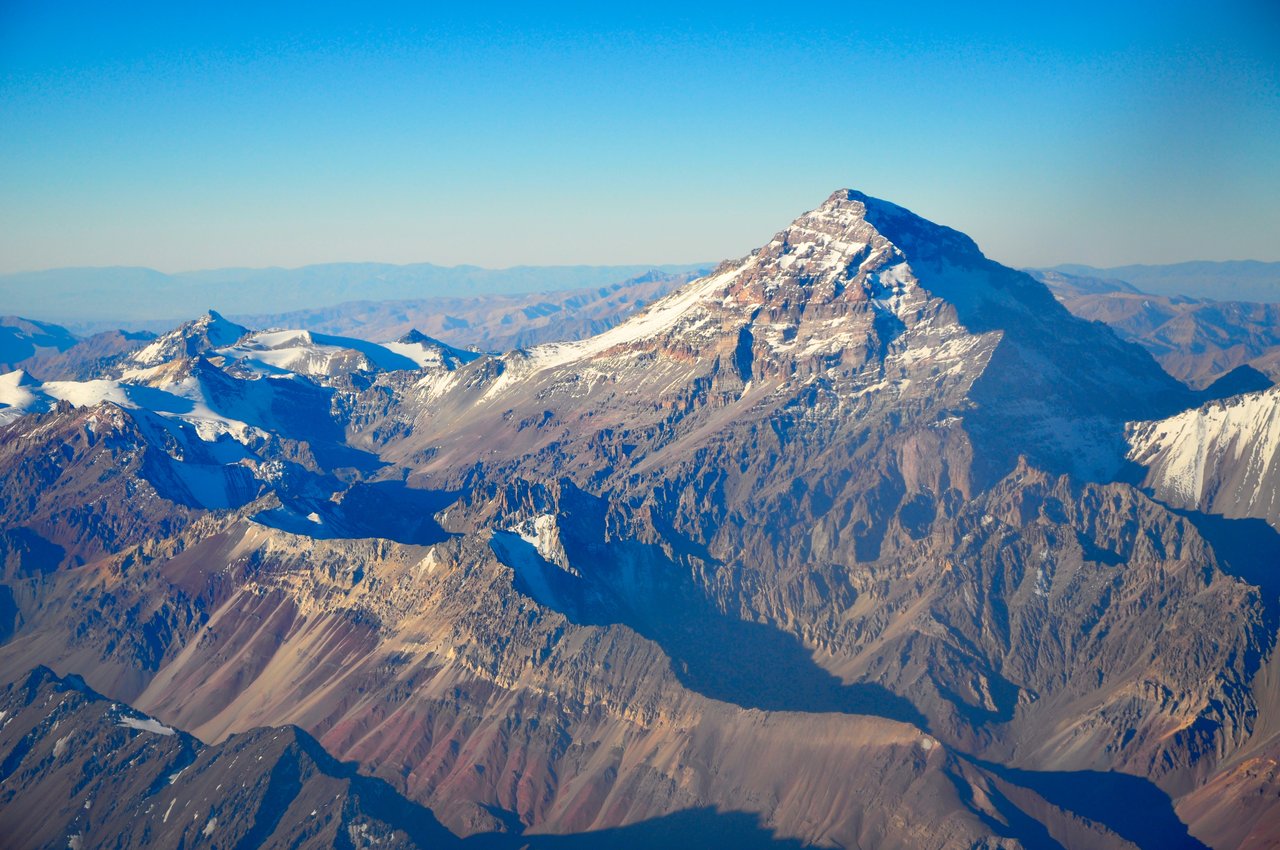
About this photo
Photo by Jorge DíazCC BY-SA 2.0
The highest peak outside Asia, Aconcagua towers over Argentina’s Andes, with vast glaciers and formidable alpine conditions.
- Region
- Andes › Southern Andes › Principal Cordillera
- Country
- Argentina
- Continent
- South America
- Coordinates
- 32.6531° S, 70.0120° W
Located in the Principal Cordillera of the Andes, entirely within Argentina's Mendoza Province, Aconcagua dominates the landscape just east of the Chilean border. Its massive silhouette rises above the Horcones and Vacas valleys, where arid, windswept slopes give way to glaciers, snowfields, and towering rock walls. The mountain stands at the heart of Aconcagua Provincial Park, a protected area encompassing fragile high-Andean ecosystems, glacial landscapes, and important water sources.
Behind its imposing profile lies a complex geological history. Aconcagua's upper rocks preserve remnants of ancient volcanic activity, while its broader structure was shaped by the immense tectonic forces that built the Andes. Layers of volcanic and sedimentary rock were folded, fractured, and uplifted over millions of years. The result is a landscape of striking contrasts: largely barren northern slopes and a monumental southern face draped in ice and hanging glaciers.
Aconcagua held significance long before the era of modern mountaineering. The discovery of an Inca ceremonial burial on its southwestern slopes in 1985 revealed its place within the sacred geography of the pre-Hispanic Andes. Its first documented successful ascent came on January 14, 1897, when Swiss mountain guide Matthias Zurbriggen reached the summit during an expedition organized by British mountaineer Edward FitzGerald. Since then, Aconcagua has become one of the world's most sought-after high-altitude objectives.
Today, most climbers approach the summit via the Normal Route, passing through the Horcones Valley, Confluencia, and Plaza de Mulas before ascending the mountain's northwestern slopes. Although this route involves relatively little technical climbing, severe cold, powerful winds, and the effects of extreme altitude demand careful acclimatization, endurance, and sound judgment. More demanding routes, including the Polish Glacier and the formidable South Face, offer major challenges for experienced mountaineers.
Beyond its summit, Aconcagua offers a remarkable opportunity to explore the high Andes. Trekking routes lead through glacial valleys and rugged mountain scenery, with viewpoints such as Plaza Francia revealing the extraordinary scale of its southern wall. Whether approached as a climbing objective or admired from the valleys below, Aconcagua remains one of the defining landmarks of the Andean landscape.

SerendiPeak
Revealing the mountain...